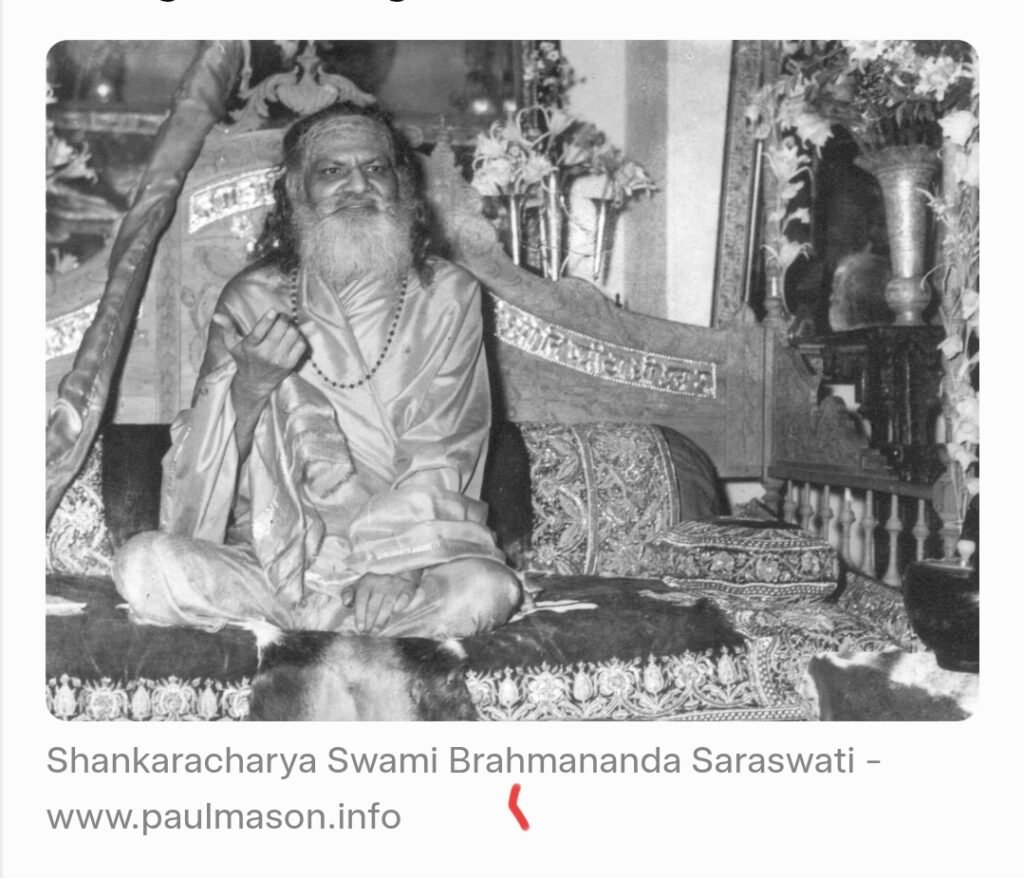
Swami Brahmananda Saraswati, lovingly known as Guru Dev or “Divine Teacher,” remains one of the most revered spiritual figures of modern India. Born in the late 19th century, he rose from humble origins to become the Shankaracharya of Jyotir Math, breathing new life into an ancient seat of Vedic learning that had remained vacant for more than 150 years. His entire existence was a living example of complete renunciation, profound scholarship, and an unrelenting inner search for divine realization. Renowned for his austere lifestyle, deep teachings on meditation and consciousness, and far-reaching influence through disciples such as Maharishi Mahesh Yogi, Swami Brahmananda’s legacy continues to guide spiritual aspirants across the globe. This account traces the remarkable details of his life journey.

Early Life and the First Stirrings of Renunciation
Swami Brahmananda Saraswati was born Rajaram Mishra on December 21, 1871 (corresponding to Marg Shirsh Shukla Dasmi 1928 in the Vikram Samvat calendar), in the small village of Gana, near the holy city of Ayodhya in Uttar Pradesh, India. While some records mention slight variations such as December 20, 1868 or 1870, the date of 1871 is most widely accepted based on traditional accounts and official biographies. He was born into a respected Saryupareen Brahmin family known for its long tradition of scholarship and devotion to Vedic principles. His father was a prosperous Brahmin, and the household atmosphere was filled with religious reverence, which undoubtedly nurtured his early spiritual inclinations.
Even as a young child, Rajaram displayed an unusual detachment from worldly concerns and a deep fascination with the divine. Stories from his childhood portray him as a prodigy endowed with an innate spiritual wisdom far beyond his years. At the tender age of nine, in 1880, he left home without warning, compelled by a powerful inner urge to find God and a true spiritual guide. He wandered toward the Himalayan foothills but was soon located and brought back home. Yet his resolve remained unshaken; he made further attempts to leave, each time demonstrating the steadfast determination that would characterize his entire life. Eventually, he succeeded in departing for good, embarking on the path of complete renunciation.
Discipleship and Entry into Sannyasa
Rajaram’s spiritual search brought him to the secluded Himalayan valley of Uttarkashi. There, at the age of fourteen in 1885, he became a disciple of the renowned Swami Krishnananda Saraswati. Under his guru’s careful guidance, he immersed himself in the intensive study of Vedic scriptures, philosophy, and yogic disciplines. Krishnananda gave him the name Brahmachari Brahma Chaitanya, signifying his dedication to celibacy and the cultivation of divine awareness. This period of discipleship extended over many years, during which Rajaram gained profound mastery of Advaita Vedanta—the non-dual philosophy expounded by Adi Shankaracharya.
A decisive turning point occurred in 1904 (or 1905 according to some sources), when he was around 33 or 34 years old, during the great Kumbh Mela held in Allahabad (present-day Prayagraj). At this sacred gathering, Swami Krishnananda formally initiated him into the order of Sannyasa, the highest stage of renunciation in the Hindu monastic tradition. He was given the name Swami Brahmananda Saraswati, meaning “the one who rejoices in Brahman (the ultimate reality) and possesses the wisdom of Saraswati (the goddess of knowledge).” This initiation formally placed him within the Dashanami Sampradaya, the monastic lineage established by Adi Shankaracharya centuries earlier.
Years of Deep Solitude and Inner Realization
After receiving Sannyasa, Swami Brahmananda chose a life of extreme solitude and austerity. He withdrew to the remote forests, jungles, and mountain regions of India, frequently dwelling in natural caves far removed from human settlements. Places such as the Amarkantak mountains, the Vindhya ranges, and various parts of the Himalayas became his homes. Living in harmony with wild animals, he sustained himself on whatever the forest provided, occasional alms, and rare offerings from devotees. This phase of intense seclusion lasted nearly three decades and was devoted entirely to deep meditation, self-inquiry, and complete mastery of the mind.
Biographical records describe him as a “Maha Yogiraj” (great king among yogis), endowed with remarkable yogic powers (siddhis) and radiating an aura of profound divine peace. He deliberately shunned public attention, concentrating solely on inner transformation. However, in 1930, during another Kumbh Mela in Allahabad, his guru Krishnananda instructed him to move closer to populated areas so that humanity could benefit from his presence. Respecting this guidance, Swami Brahmananda established an ashram in Varanasi (Benares), which soon became a center for genuine spiritual seekers. He began offering public teachings, sharing profound insights into Vedanta, yoga, and the path to enlightenment. In 1936, he founded the Brahma Niwas ashram, further extending his reach.
Ascension to the Seat of Shankaracharya and Revival of Jyotir Math
For more than 150 years, the Jyotir Math—one of the four principal monasteries established by Adi Shankaracharya in the 8th century—had remained without an appointed Shankaracharya, resulting in a gradual decline of its influence. Throughout this time, religious leaders from across India repeatedly appealed to Swami Brahmananda to accept this exalted responsibility. He consistently declined, preferring the silence of his solitary life. After almost twenty years of persistent requests, including strong encouragement from his disciple Swami Karpatri and other prominent figures, he finally consented.
On April 1, 1941, at the age of 70, Swami Brahmananda was ceremonially installed as the Jagadguru Shankaracharya of Jyotir Math during the ninth session of the All India Sanatan Dharma Maha Sammelan in Varanasi. The installation received widespread support from ruling princes, religious organizations, and a national consensus, marking a historic moment of revival for the ancient institution. As Shankaracharya, he traveled widely across northern India, delivering powerful discourses on Vedic principles, strengthening monastic discipline, and promoting spiritual education. India’s first President, Dr. Rajendra Prasad, honored him as “Vedanta Incarnate” for his living embodiment of non-dual philosophy.
During his tenure from 1941 to 1953, he maintained utmost simplicity, refusing material offerings and focusing entirely on inner growth. He supported the establishment of Vedic schools and ashrams and consistently taught the essential unity underlying all religions while firmly upholding the authority of Hindu scriptures. In 1952, he spent a month in Delhi, where he addressed the press and delivered “Dharmopdesh” (spiritual guidance), advising national leaders to seek the counsel of wise sages for balanced and righteous governance.
Teachings and Enduring Spiritual Legacy
Swami Brahmananda’s teachings revolved around Advaita Vedanta, the practice of yoga, and the use of mantra meditation. He guided disciples to choose an Ishta-Devata (personal deity of devotion) and begin with mantra repetition using a rosary, gradually advancing to silent mental repetition that leads to transcendence of thought and direct experience of pure consciousness. Drawing from Patanjali’s Yoga Sutras, he explained that yoga is “the cessation of the fluctuations of the mind” (yogash chitta vritti nirodhah), which ultimately reveals the eternal, unchanging Self.
His spoken teachings were later compiled into volumes such as Amrita Kana, Shri Shankaracharya Upadeshamrit, and 108 Discourses of Guru Dev. These works combine deep philosophical insight with practical, accessible guidance. He taught that all genuine paths to the divine are valid and encouraged harmony among different religious traditions. Recordings of his voice and devotional songs still exist, preserving the living presence of his wisdom.
Among his most prominent disciples were Swami Karpatri (founder of the Akhil Bharatiya Ram Rajya Parishad), Swami Shantanand Saraswati (his successor at Jyotir Math), and Maharishi Mahesh Yogi, who brought Transcendental Meditation to the world, always crediting Guru Dev as the source of his inspiration. Through Maharishi’s efforts, millions have been introduced to mantra-based meditation practices, many of which continue to honor Swami Brahmananda’s image in ceremonial reverence.
Final Years, Passing, and Succession
In his later years, despite increasing health difficulties, Swami Brahmananda remained dedicated to his mission. He left his body on May 20, 1953 (Vaisakh Shukla Saptami 2009), in Kolkata (then Calcutta), at the age of 81 (or 83 according to some accounts), due to jalodara (dropsy or edema). His body was transported by train to Varanasi, where it was traditionally immersed in the sacred Ganges River at Kedar Ghat in a stone casket—a customary jal samadhi performed for great saints.
The question of succession proved controversial. A purported will named Swami Shantanand as successor, who was installed on June 12, 1953. Disputes followed, briefly involving Swami Krishna Bodhashram. In time, the lineage stabilized, and subsequent Shankaracharyas, including Swami Swaroopananda Saraswati, continued to uphold the tradition.
Swami Brahmananda Saraswati’s life stands as a timeless example of the pursuit of ultimate truth, harmoniously blending the rigor of ascetic discipline with compassionate guidance for humanity. Serving as a vital link between the ancient Vedic tradition and the modern world, his influence lives on through the revival of sacred institutions, the spread of authentic meditation practices, and the enduring inspiration he continues to offer to all who seek inner peace and self-realization.