In the golden dawn of creation, beneath the timeless gaze of the Himalayas, Swyambhuva Manu’s daughter Prasuti bloomed into the embrace of Daksha Prajapati—the architect of worlds, swollen with the pride of progeny. Sixteen luminous daughters blossomed from their union, yet the youngest, Sati, shone like moonlight on snow—radiant, devoted, destined to wed the One who dances beyond birth and death: Lord Shiva, the ascetic sovereign of Kailash, whose third eye holds the fire of dissolution and whose silence cradles the universe.

But even divine unions bear shadows. The storm gathered in a celestial assembly where stars themselves bowed low. Daksha, crowned as lord of the gathering, strode in like thunder clothed in arrogance. All rose—gods, sages, luminaries—save two: Brahma, the grandfatherly creator, and Shiva, the motionless meditator.
Daksha’s heart ignited. “This wild-haired yogi, smeared in ash, my own son-in-law, dares sit while I enter? He who wears skulls and dances with ghosts—how dare he scorn me!” Venomous words poured forth like poison rivers: “Monkey-eyed ascetic! Kapali! Outcast!” Shiva, lost in the infinite ocean of samadhi, heard nothing. The insults fell upon him like rain upon a mountain—unfelt, unheeded, dissolving into stillness.
Enraged by the silence that shamed him more than any retort, Daksha raised consecrated water and pronounced the curse: “Never again shall you taste the nectar of sacrifice! No share in any yajna shall be yours!”
Nandishwara, the sacred bull whose heart beat only for his Lord, roared in fury. “O puffed-up creator, forever chanting ‘I, I’—may you wander as a goat in your next birth, bleating ‘me, me’ in endless humility!”
Curses cascaded like monsoon torrents: Bhrigu damned Shiva’s devotees to tamasic ways; Nandishwara condemned the priests’ wisdom to mere survival. Amid the gathering darkness, Shiva rose—serene, untouched—and withdrew to the snow-capped silence of Kailash.
Yet the tale was far from finished.
Daksha, nursing his wounded pride, kindled a grand yajna at sacred Kankhal, inviting every deity except the one he despised. Flames leaped skyward, mantras echoed, but the heart of the rite was hollow—tainted by exclusion.
Deities passed Kailash on their way, bowing to Shiva. Sati, watching from the peaks, felt the pull of blood and duty. “My Lord,” she pleaded, eyes like lotus pools, “your father-in-law hosts this splendor—shall we not grace it?”
Shiva, knowing the storm to come, spoke gently: “Beloved, the scriptures allow uninvited entry to guru, parent, friend—but when the door is slammed by hatred, crossing the threshold brings only sorrow.”
Sati’s heart waged war—love for husband against love for father. In a blaze of emotion, she departed alone, Shiva’s ganas trailing like faithful shadows. He whispered to them: “Follow your mistress. She will not return.”
At the yajna, the truth struck like lightning: no seat for Shiva, no offering, no whisper of his name. Sati’s soul erupted. “Foolish father!” she cried, voice trembling with divine fire. “Who in all the worlds dares oppose Mahadeva—the ocean of compassion who pours himself out for every devotee?”
Turning to the northern altar, she summoned the inner blaze of yoga. Flames rose like crimson lotuses, enveloping her form. In that final act of protest, Sati became pure light, ascending beyond the body her father had given.
When the news reached Kailash, the immovable One stirred. For the first time, fury awakened in the destroyer. He tore a dreadlock from his matted hair and hurled it to earth. From that thunderous impact rose Veerabhadra—colossal, three-eyed, trident-wielding terror, born of Shiva’s wrath.
“Go!” commanded the Lord. “Sever Daksha’s head. Shatter the yajna born of ego.”
Veerabhadra descended like cosmic lightning. The earth quaked. The sacrificial hall became a battlefield of ruin: Bhrigu’s proud beard torn away for his mockery; Pushan’s gleaming teeth shattered for his mocking grin; Bhaga’s eyes gouged for silent encouragement. Then, with a single sweep, Daksha’s head rolled—cast into the very flames he had kindled.
Chaos reigned. The yajna lay in ashes, a monument to pride’s futility.
Brahma, leading the broken gods, approached Shiva with folded hands: “Merciful One, revive the yajman. Let the rite complete its circle.”
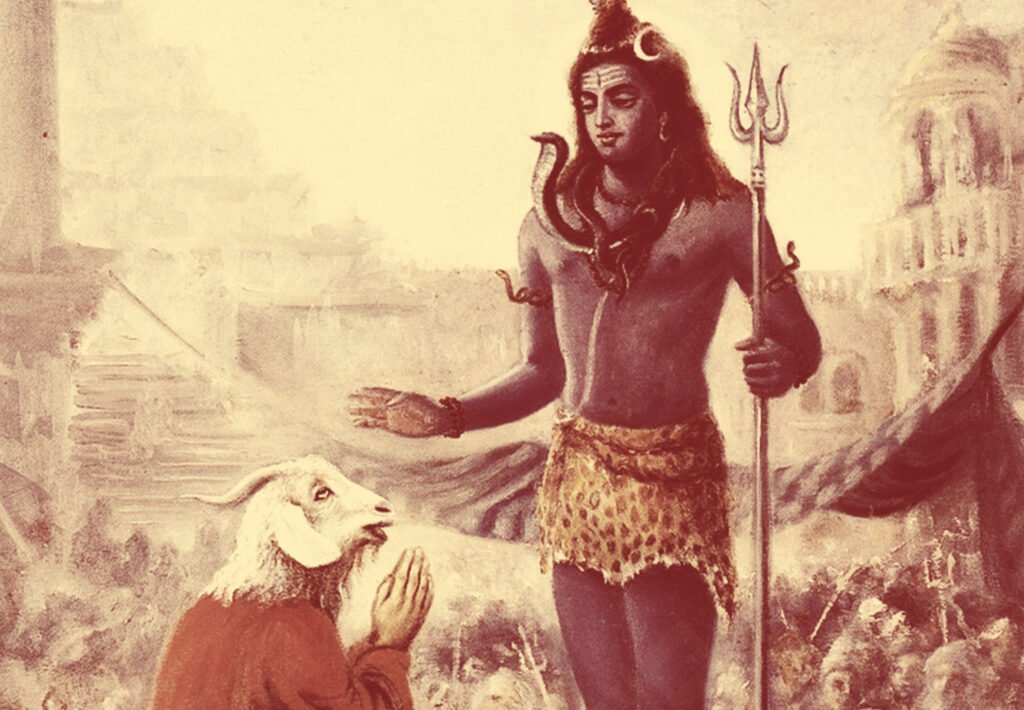
Shiva smiled—the smile that ends and begins worlds. “Bring the head of the sacrificial goat,” he said softly.
Why the goat? Because Nandishwara’s curse had foretold it. Shiva, in infinite compassion, chose not to wait for another life. The goat’s head was placed upon Daksha’s shoulders. Life returned. The creator awoke—humbled, transformed. He sang praises to the destroyer, begged forgiveness, and the yajna bloomed anew, now purified by surrender.
Sati returned as Parvati, daughter of the mountains, her spirit forged in fire. Through fierce tapas she reunited with Shiva, their bond now eternal, unshakeable—wisdom born of pain.
Herein lies the eternal song:
Ego cries “I, I” — and earns the bleat of the meek goat.
Rituals poisoned by hatred burn to ash.
Honor every form of the divine, yet worship with undivided heart.
Before the Guru and God, lay down the sword of intellect; offer only faith, surrender, obedience.
In the dance of Tandava, destruction births creation. In the silence of meditation, fury melts into mercy.
Har Har Mahadev! 🙏
Here are vivid glimpses from this timeless saga: 9 “LARGE”
Lord Shiva in serene meditation upon Kailash—the still center before the storm. 0 “LARGE”
Sati’s fiery self-immolation amid the sacred flames—a blaze of protest and purity. 7 “LARGE”
Veerabhadra unleashing destruction upon the yajna—the fury of divine justice. 17 “LARGE”
Daksha revived, crowned with the goat’s head—symbol of humbled pride and boundless mercy.